When Ability Is All That's Remembered

"MJ, I love you. I hope that somewhere deep down, you love me too. Until then, let me just be Spider-Man." Peter pulls the mask down, steps off the ledge, and throws himself entirely into the identity of Spider-Man.
That is an early scene from Spider-Man: Brand New Day, released in July 2026. Forgotten by the world, Peter has written MJ a letter he cannot bring himself to let her read. He has spent his whole university career alone. Over those four years, on his own effort alone, crime in New York has fallen to a historic low. He can hold a dozen things together at once, almost without a seam, judging even the fine proportions of heroism exactly right. On the evening news, people speak into the camera to praise him: the kind of superhero adults trust and children want to become.

Anyone who has followed the Spider-Man films knows the line: with great power comes great responsibility. In this version, it is what Aunt May says to Peter before she dies. And for Peter, the only way to make up for the past is to live out what she entrusted to him. So we watch him return, after every rescue, to lay a fresh bouquet at her grave.
But the line takes on another shape in his life. As the responsibility grows, his ability has to grow with it. And he manages it, to the point of near perfection. The cost is that inside his own life, Spider-Man keeps getting larger and Peter keeps getting smaller. The more he can do for others, the less often he thinks of himself. On one side, a superhero the whole city praises. On the other, a young man sitting alone in an empty apartment that no one visits. Busyness becomes his most effective painkiller.
Through the film he keeps ignoring his headaches, until a severe shock triggers a mutation in the spider genes in his body. Ev, his AI assistant, tells him that prolonged isolation or emotional trauma may have brought the change on. He says he is fine. Ev says he does not look fine, and suggests he might need to take some time to bring his life back into balance.
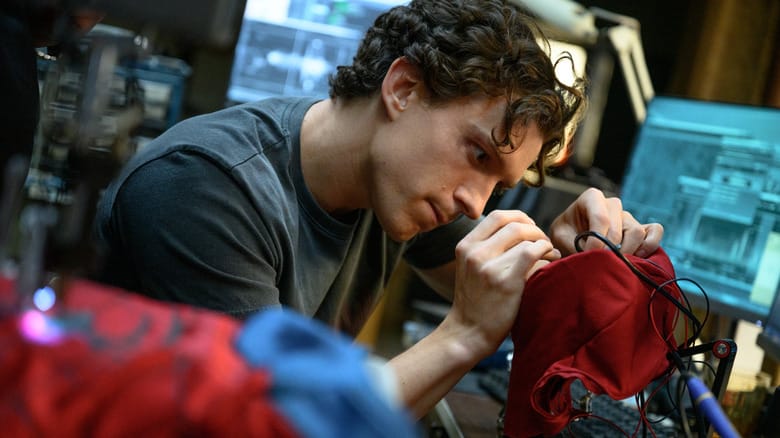
Peter answers: "But I don't have that option, do I?"
No one is forcing him. He is the one who says he has no choice.
No One Demanded It of Him. He Demanded It of Himself.
The achievement society is the central concept the philosopher Byung-Chul Han uses to describe the operating logic of the twenty-first century. His judgment is that we have left behind an order founded on prohibition and discipline. The old power spoke in the form of "you may not" and "you must." The contemporary form is "you can" and "everything is possible." This apparently liberating shift in fact does no more than move the pressure from the outside to the inside. Compulsion is no longer imposed by another; it issues from the subject himself. Its operating principle is therefore no longer negativity but positivity, and indeed an excess of positivity.
To be fair, there are far fewer people making demands of us than there once were. No one prescribes what we should be doing at a given hour, and class and station no longer hold people in place. But precisely because the external limits have withdrawn, our circumstances are now entered entirely in our own name. And so we come to believe that only through self-realization can we accomplish our own salvation: produce something, and your existence counts. Meaning is no longer given. It has to be bought with performance.
A Nike slogan could almost serve as the creed of the age: "It's only crazy until you do it. Just do it." The line commands no one. It simply opens a door and makes everything appear possible.
Peter's situation is exactly this. No employer reviews his performance. No family makes demands of him. Nobody around him even knows what he does. For four years he has handled every part of it alone, without a flaw, and the only thing driving him is himself. This is precisely the condition Han describes: the line between oppressor and oppressed has disappeared, and a person is at once employer and employee. His wording is blunt. This kind of self-exploitation is more efficient than external servitude, because it is carried out in the name of exercising one's freedom. Forced labour always meets resistance. Voluntary self-realization does not. The problem is therefore not that people cannot resist, but that they can hardly recognize what there is to resist, because the one applying the pressure is themselves.
Every Benefit Becomes a New Demand
The rapid development of technology in recent years has made this mechanism run faster. Social media has given people a channel to be seen, at the cost of living from then on inside a constant comparison. Likes, follows and subscriptions turn recognition into something countable, and anything that can be recorded as a number always leaves room to grow. Artificial intelligence has entered study and work under the banner of empowerment and efficiency. It does let people work faster, and yet the time it saves becomes the possibility of doing still more. Remote work spares us the commute and the small talk of the office, and what it brings in return is the disappearance of the boundary between work and life, so that any hour of the day now holds the possibility of work. And as the barriers to side projects, portfolio careers and starting a business have come down, self-realization has come to seem more full of possibility than ever before.
These developments really have raised efficiency, and the freedom they give is genuinely felt. But they have also gradually removed our reasons to stop. What is left at the end is a person who drives himself constantly and has no one to call time.
Consumer culture takes this to its limit. It does not merely lead people to measure everything by consumption; in the end the self caught up in it becomes a commodity as well. There are now courses with titles like "Run your life the way you would run a company." The sociologist Zygmunt Bauman observed that everyone today is required to make himself into a commodity with market value, constantly updating, packaging and marketing himself, and to do so willingly, even enthusiastically.
Nothing Is Guaranteed to Last
When people today lose faith, it is not simply that they stop worshipping God or believing in a life to come. The real change happens in how people hold their ordinary lives. To people now, life appears extremely brief and fleeting. Human beings have never felt so strongly that nothing can be held on to. And it is not only human life that is brief. It is the whole world. Work cannot be held, relationships cannot be held, an address cannot be held, and even who we are keeps being updated. Nothing can be guaranteed to remain.
This scarcity of a sense of being easily grows into anxiety, nervousness, even hyperactivity. And so people respond in an almost hysterical fashion: more activity, more labour, more output, as though as long as they do not stop, they will not have to face the question.
People are not anxious because they are busy. They are busy because they are anxious.
So Peter habitually wears the mask. The mask was originally there to protect the person Peter is, to let him keep hold of an ordinary life. By this film the function has been completely inverted: the mask no longer protects the person, it has replaced him. The world knows Spider-Man. No one knows Peter. The mask earns him praise and costs him being known.
Praise requires a piece of work, and so people make a piece of work out of themselves. Before it goes out we choose the angle, retouch the image, weigh the wording, imagine in advance how others will read it. Sherry Turkle has said that the motto of modern people has become "I share, therefore I am," and what gets shared is by definition editable. Editable means retractable, and that is exactly where its reassurance lies, and exactly why it cannot buy us being known. Because the condition of being known is that someone has seen the parts of us we cannot edit: how we look when we are not doing well, how we look when we have made a mess of things, how we look when we do not know what to say. By definition, none of that appears in the display. So more praise does not necessarily mean being better known, and sometimes it means the opposite: the more completely a person is displayed, the less chance there is of being really seen. And the version that gets praised turns around and becomes a standard that must be maintained. What pushes us is no longer anyone's demand, but our own past performance. We are competing with a previous version of ourselves, and that version only becomes harder to surpass. Asking for help therefore becomes nearly impossible. To say out loud that I cannot carry this is to admit that all the earlier praise was a misunderstanding. People would rather keep carrying it than let the praised image collapse. This is what Peter has been doing for four years.
When Timothy Keller describes the situation of modern people, his central image is a courtroom. He says that every person lives every day inside a trial, and the only difference is who sits on the jury. People once handed the verdict to their family and their community. People today are told to pass judgment on themselves. But Keller points out that this does not work, because no one can actually do it. So we hand the verdict over after all, only now to grades, appearance, sales figures, follower counts, and the eyes of the people whose opinion we care about.
Where is Peter's courtroom? On that television screen, in the praise of the citizens of New York, and at Aunt May's grave. Every bouquet he lays down after a rescue is a report to a juror who is no longer there: I did not let you down today either. That line, with great power comes great responsibility, began as an older woman's blessing at the end of her life. By this point it has become an assignment that can never be handed in.
Because You Are You
It is worth noticing that what Aunt May left Peter was not only that line about power and responsibility. Later in the film we learn that she said something else as well. She said that all of this was going to become very frightening, that everything would change at a speed we cannot imagine. She said: Peter, you are someone special, and I hope that will always be something you are proud of, but I know there will be times when you do not feel that way. There will be times when you feel alone, and times when your being special is exactly why people treat you in dark and brutal ways. And then the crucial sentence: the people who truly love you do not love you because you are special. They love you because you are you. She wanted him to remember this, above all at the moments when he felt completely alone. She even said that this was his most important responsibility.
Those words overturn the entire logic Peter has been living by for four years. He has assumed all along that he must use the part of him that is special to repay, to prove, to give an account. What Aunt May told him is that what the people who love him love is simply the person he is.
A Portrait
This film draws a portrait of a certain kind of young person in our time.
He works hard, so hard that he appears to need no one's help. The calendar is full, the competence is dependable, what he hands in is polished. When he is praised, he lets it pass lightly.
He is afraid of losing, and so he withdraws before anything can be lost. Rather than take the risk of rejection by drawing near to someone, better to watch from a distance, where at least nothing can be taken away. It is not that he does not long for relationship. It is that he cannot afford to lose one again.
He carries something from the past. Perhaps a family's expectations, perhaps a decision he did not get right, perhaps a person he feels he failed. And so underneath everything he does there is a voice saying: this time it has to be right, this time there can be no mistake.
He thinks a great deal. He weighs a message over and over before sending it, rehearses in his head before speaking in a meeting, and on the way home after a gathering he is still going back over whether what he said was out of place. His body speaks for him before he does: headaches, sleeplessness, palpitations, a large anger over a small thing. And his first response is usually, I'm fine.
None of this is written in order to judge how he ought to live, but to help us understand the young people of this age, and to understand ourselves within it.
At the same time, this is worth affirming: it is precisely this kind of lived experience that carries its own value. Peter grew from a boy whose one wish was to join the Avengers into a hero who blesses an entire city without anyone knowing his name. He is genuinely alone and he genuinely struggles, and still he keeps giving, still he holds to what he believes.
Finding a Way Through: For Those of Us Who Are Holding On
"Our calendars are more honest than we are. They have already said where our hearts are."
Jesus said that where your treasure is, there your heart will be also. The heart cannot be seen, but through what we pursue we can tell what condition it is in.
So rather than asking what it is I really want, it is better to ask a few more concrete questions. Where does my time go? What am I most afraid of losing? How do I want others to see me? Perhaps knowing our own hearts can begin with those answers.
"A life is not a drinking glass."
In Antifragile, Nassim Taleb sets out an unusual classification. Fragile things break under shock. A glass is like this, and so the way we treat it is to keep it from being knocked. Robust things are unharmed by shock. A stone is like this; it holds, but it does not become better for it. There is, however, a third category, which grows stronger under shock, and this he calls antifragile. Muscle is like this. Weight tears the fibres, and they grow back stronger than before. Our lives belong to that third category. Life therefore does not require every step to be the right one, because we are not the kind of thing that shatters at a touch. Those choices that look inadequate in hindsight are not damage. They are experience. The margin for error in a life is far wider than we assume.
"What makes a person stronger is never pressure by itself. It is pressure plus recovery."
But antifragility comes in doses. The same weight may build muscle or tear a tendon. The difference is not only in the weight. It is in whether there is recovery, whether there is provision, whether there is anyone nearby. The weight in the gym can make us stronger because a coach is watching, because the set comes to an end, because food and sleep follow after. Peter's four years had none of these three. So it was not training. It was attrition.
Suffering by itself does not make a person grow. Suffering plus recovery does.
"The question is not how well we fought this one battle, but whether we can keep going further."
In The Infinite Game, Simon Sinek distinguishes two kinds of game. A finite game has fixed rules and an endpoint, and the object is to win. In an infinite game the players change, the rules change, there is no endpoint, and the object is not to win but to keep the game going. Guarding a city, loving a person, becoming a good human being: all of these belong to the second kind. And human suffering often comes from playing an infinite game by finite means. We draw ourselves a finish line that does not exist. Once the goal shifts from winning to going further, what we need changes with it. Someone who wants to win needs a stronger will. Someone who wants to go far needs six things: rest, training, provision, room for error, growth, experience.
Finding a Way Through: For Those of Us Who Walk Alongside
"What he lacks is not applause. It is a place where he is allowed to be imperfect."
If there is a young person near us who is capable, considerate, and never gives anyone cause for concern, please pay particular attention to him. That is the child most easily overlooked, because he causes no trouble. And the reason he causes no trouble may well be that he learned long ago that being needed is safer than being known.
Give him room to recover, rather than only asking him to grow. Since it is pressure plus recovery that makes a person stronger, our task after he has carried a heavy stretch is not to add to the load, but to make sure he sleeps enough, eats well, and has people around him.
Those who walk alongside can also let young people see who they really are. Share your own experience, and share your own weakness too. When we take our own masks off at the right moment, we stand a far better chance of reaching what lies behind theirs.
One Last Image
What gets Peter back on his feet late in the film is not that he has become strong again. It is that the road he has walked becomes help for someone else. He meets Jean Grey, who is just as frightened of her own power. What actually helps Jean is not Peter's ability, and not the technique of four years' practice, but the words Aunt May left in him: the people who truly love you do not love you because you are special, they love you because you are you.

So if today we are also in a place no one knows about, carrying a great deal on our own, this is what I would want to leave with you.
Our effort is precious, and the low ground we have walked through may one day become a marker for someone else. But the reason we are allowed to stop is not that we have finished, and not that we have proved anything.
It is that long before the whole world knew Spider-Man, someone already knew Peter.
The same is true for us. We do not have to become perfect first in order to be worth knowing.
Suffering produces endurance, endurance produces character, character produces hope, and hope does not put us to shame. (Romans 5:3-5)
Further Reading
Byung-Chul Han, The Burnout Society
Zygmunt Bauman, Liquid Love: On the Frailty of Human Bonds
Sherry Turkle, Alone Together: Why We Expect More from Technology and Less from Each Other
Timothy Keller, The Freedom of Self-Forgetfulness: The Path to True Christian Joy
Nassim Nicholas Taleb, Antifragile: Things That Gain from Disorder
Simon Sinek, The Infinite Game
Irvin D. Yalom, Staring at the Sun: Overcoming the Terror of Death